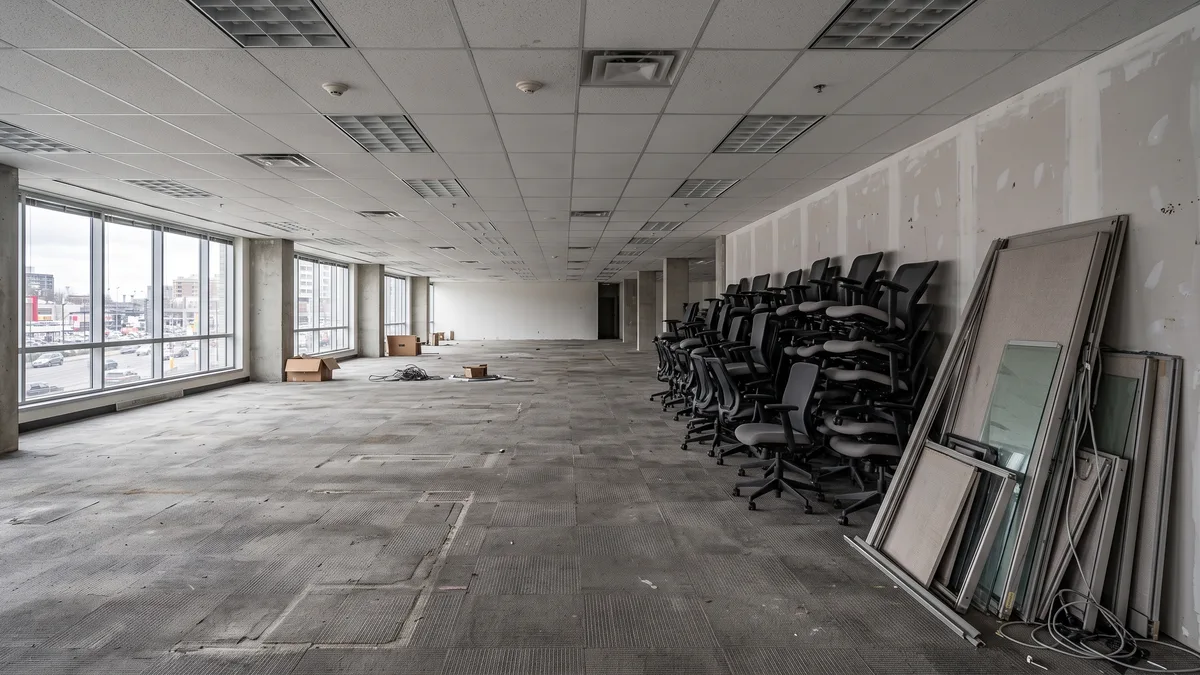
Business cleanouts run on different rules than household jobs. There is usually a hard deadline, often a commercial landlord involved, and the physical work frequently has to happen outside standard business hours. If you are clearing an office suite, retail storefront, or job site in Wake County, here is what to plan for.
Common Commercial Jobs
Most commercial cleanouts fall into a few primary categories:
- Office cleanouts — desks, cubicle partitions, task chairs, and filing cabinets. Larger office transitions often call for dedicated office furniture removal services to dismantle modular pieces safely.
- Retail fixtures — display units, clothing racks, shelving, checkout counters, and promotional signage from store remodels or closures.
- Restaurant equipment — commercial prep tables, kitchen appliances, dining tables, chairs, and walk-in storage racks.
- Construction debris — scrap drywall, framing lumber, flooring, carpet tiles, and fixtures left over from commercial tenant upfits.
- Property management turnovers — clearing units between commercial leases, including abandoned inventory and left-behind tenant items.
- Warehouse clearing — pallets, industrial metal shelving, obsolete stock, and packaging materials that tie up floor space.
Commercial Junk Removal vs Regular Trash Pickup
Many managers assume routine dumpster service can handle cleanout waste. In practice, municipal collection and standard commercial dumpsters operate under strict rules that make them unsuitable for bulk cleanouts.
Dumpster contracts cover routine waste like packaging and food refuse. Haulers require waste to fit inside closed containers. Overfilled bins incur fees, and drivers will not load bulky furniture, heavy materials, or loose items left outside.
Standard trash pickup includes zero labor. Your team must carry, break down, and load everything, pulling staff from core work and risking injury.
Dedicated commercial junk removal provides an on-demand, full-service solution. A professional crew provides the vehicles, tools, and labor to clear bulk items directly from your suite, warehouse, or dock in a single scheduled appointment.
What Makes Commercial Different
A few distinct factors change how commercial cleanouts operate compared to residential jobs:
Timing matters more. Most offices, clinics, and storefronts cannot have hauling crews moving furniture through corridors during work hours. Workstation breakdown while customers or employees are present creates noise, bottlenecks, and safety concerns. Early morning, evening, or weekend dispatch windows are frequently required.
Building access and property rules. Commercial office parks and downtown buildings involve shared infrastructure. Multi-tenant properties often enforce specific rules regarding freight elevator reservations, loading dock hours, and service routes. Many buildings also require vendors to meet specific insurance and documentation requirements before starting on-site work, so check with property management early.
Volume and physical scale. A typical office floor with cubicles, desks, and storage closets can fill multiple truckloads. Large cleanouts often require staged scheduling across several trips to avoid blocking shared loading bays.
Data security. Cleanouts involve electronics and paperwork. Computers, hard drives, and filing cabinets require segregation so sensitive data is secured before materials are recycled.
Disassembly complexity. Commercial furniture is built for durability. Desks, conference tables, and cubicles are bolted together, requiring tools and care to protect walls, doorways, and elevator interiors.
Lease-End Cleanouts
When vacating leased commercial space in Wake County, the cleanout directly impacts your deposit return. Commercial leases mandate returning the property in broom-clean condition by an agreed handover date.
Broom-clean condition generally requires:
- Desks, cubicles, chairs, and freestanding equipment removed
- Tenant-installed shelving, custom cabinetry, and signage taken down
- Storage closets, server rooms, and utility spaces cleared completely
- Floors swept and carpets vacuumed with all debris hauled away
- Handover completed on or before the lease termination date
Missing a deadline can trigger steep holdover rent penalties. Property managers frequently rely on professional property cleanout services to clear left-behind items quickly so units can be re-leased without delay.
To avoid deposit disputes, arrange a preliminary walkthrough with property management two weeks before move-out, then book your cleanout crew with a two-to-three-day buffer before key surrender.
What Affects the Cost
Commercial pricing works on volume, same as residential, but a few factors weigh heavier:
| Factor | Why it matters |
|---|---|
| Total volume | The main driver — how many truckloads |
| Access | Stairs, no loading dock, or long carries add labor |
| Scheduling | After-hours or weekend work may cost more |
| Item types | Heavy equipment and appliances take more handling |
| Timeline | Compressed deadlines may need larger crews |
For pricing details, see our junk removal cost guide. For commercial jobs, we review photos or walk the space before quoting.
Recycling and Disposal for Businesses
Businesses often follow corporate sustainability goals. A good removal service sorts items responsibly:
- Office furniture in usable condition can often be donated or reused
- Electronics go to certified e-waste facilities for materials recovery
- Metal from desks, shelving, and racking is sorted for scrap recycling
- Cardboard and paper are bundled and sent to recycling processors
- Construction debris like scrap lumber and drywall is sorted for recycling where possible
Prioritizing donation and recycling keeps usable material out of local landfills and supports regional reuse.
Planning a Commercial Cleanout
A few practical steps make the process run smoothly:
- Walk the space and estimate volume before booking
- Confirm building access rules — verify elevator reservations and loading dock hours
- Separate items to keep and label them clearly
- Secure confidential documents and data drives before the crew arrives
- Build in buffer time ahead of lease expirations or contractor start dates
Frequently Asked Questions
What types of businesses use commercial junk removal?
We serve offices, retail stores, healthcare clinics, restaurants, property managers, warehouses, and contractors. Jobs range from single-item pickups to complete office clearouts.
Do you remove office furniture and cubicles?
Yes. Crews disassemble, carry, and haul away desks, chairs, conference tables, filing cabinets, and cubicles, protecting doorways and elevators throughout.
Can you remove construction and renovation debris?
Yes. Cleanouts frequently include drywall scrap, framing lumber, flooring, ceiling tiles, and fixtures from commercial remodeling or tenant upfits.
How much does commercial junk removal cost?
Pricing is volume-based, scaling with truck space occupied, material density, and site access. Commercial cleanouts start around $199, with larger jobs quoted after photo review or a walkthrough.
Can removals be scheduled outside business hours?
Yes. Cleanouts can be scheduled for early mornings, evenings, or weekends to prevent disruptions to your daily operations, staff, or customers.
Our Commercial Services
We handle construction debris removal, office cleanouts, and property management work across Wake County:
- After-hours and weekend scheduling
- Multi-day jobs for larger spaces
- Repeat work for property managers and contractors
- Sorting for donation and recycling
- Broom-clean finish
We provide commercial junk removal services in Apex and can quote a single job or set up recurring service if you’re clearing units regularly.
Serving Businesses Across Wake County
We work with businesses in Apex, Cary, Holly Springs, Fuquay-Varina, Morrisville, New Hill, Willow Spring, and Garner.
Get a Commercial Quote
If you’ve got a space that needs clearing, Apex Junk Removal Pros can work around your schedule and your deadline. Request a free estimate and we’ll get you a firm number.